
Mag Meter vs Mechanical Flow Meter — Which is Right for Your Canterbury Irrigation Scheme?
If you're installing a new irrigation flow meter or replacing an ageing one, the choice between an electromagnetic (mag) meter and a mechanical (turbine) meter comes up quickly. Both will measure your water take and satisfy ECan consent requirements — but they're quite different instruments, and the right choice depends on your specific situation.
This guide compares the two technologies across the factors that matter most for Canterbury irrigation: accuracy, maintenance, verification intervals, cost, and suitability for local conditions. NZ Flow Group supply both types and will always recommend the meter that's right for your application — not the one that's easiest for us to sell.
How each meter works
Before comparing them, it helps to understand the basic operating principle of each type.
Electromagnetic (mag) flow meters
Mag meters work on Faraday's law of electromagnetic induction. The meter generates a magnetic field across the pipe, and as conductive water flows through it, a small voltage is induced. The meter measures that voltage and converts it to a flow rate. There are no moving parts — the measurement happens entirely through the pipe wall and the water itself.
Mechanical (turbine) flow meters
Mechanical meters use a rotating impeller or propeller driven by the flow of water. As water passes through the meter, it spins the impeller, and the rotation rate is converted to a flow rate. The measurement depends on the physical movement of components inside the meter.
That fundamental difference — moving parts vs no moving parts — drives most of the practical differences between the two types.
Accuracy
Mag meters are highly accurate across a wide flow range, typically ±0.5% or better under good conditions. They maintain accuracy well over time provided the electrodes stay clean and the installation is correct.
Mechanical meters are accurate when new and in good condition, typically ±2% or better, but accuracy degrades as the moving parts wear. Bearing wear, impeller fouling, and sediment damage all reduce accuracy over time — which is why mechanical meters require more frequent verification.
For ECan consent compliance, both meter types are capable of meeting the ±5% accuracy requirement. However, a mag meter will hold that accuracy more reliably over a longer period.
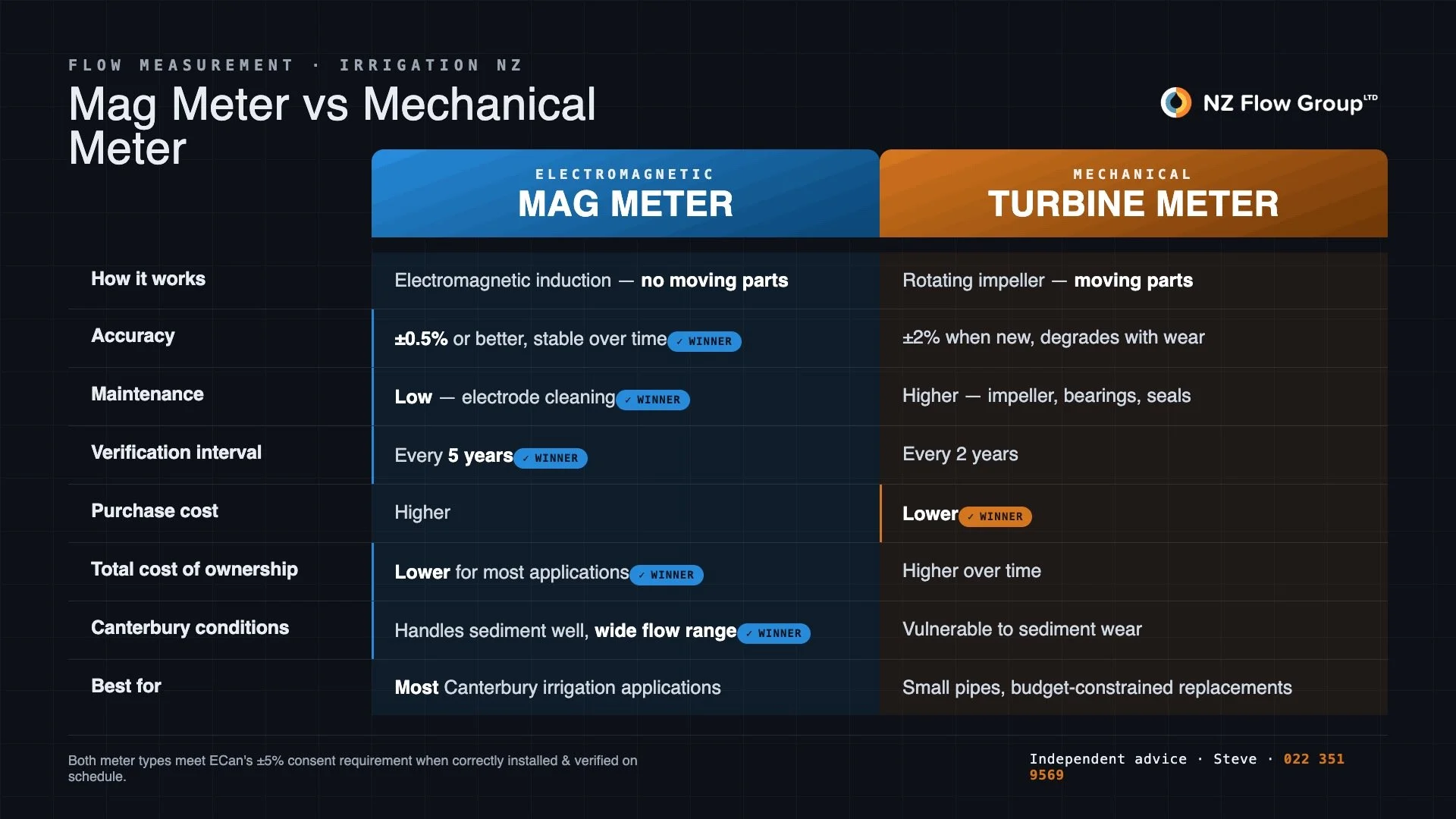
Verdict: Mag meter — more consistent accuracy over time.
Maintenance requirements
Mag meters have no moving parts, which means there's very little to maintain between verification cycles. The main maintenance task is electrode cleaning — in Canterbury's irrigation water, which often carries sediment, organic matter, or mineral deposits, electrodes can foul over time and affect accuracy. Regular inspection and cleaning is straightforward and can usually be done as part of a routine service visit.
Mechanical meters require more regular attention. The impeller, bearings, and seals are subject to wear and need periodic inspection and replacement. In Canterbury irrigation conditions — particularly where the water carries sediment or grit — mechanical wear accelerates and maintenance requirements increase.
Verdict: Mag meter — lower maintenance over the life of the meter.
Verification intervals
This is one of the most practical differences between the two types, and one that's often overlooked when comparing purchase costs.
Under ECan consent conditions and the Resource Management (Measurement and Reporting of Water Takes) Regulations 2010:
Mag and ultrasonic meters — verified every 5 years
Mechanical meters — verified every 2 years
That means over a 10-year period, a mechanical meter requires five verifications compared to two for a mag meter. At current verification rates, that difference adds up to a significant cost — often enough to offset a meaningful portion of the price difference between the two meter types.
Verdict: Mag meter — less frequent verification, lower long-term compliance cost.
Purchase cost
Mag meters cost more upfront than mechanical meters. For a standard irrigation application, the price difference can range from a few hundred dollars for smaller pipe sizes through to more significant amounts for larger diameter mains.
Mechanical meters are generally less expensive to purchase, which makes them attractive when upfront cost is the primary consideration.
However, when you factor in:
More frequent verification (every 2 years vs every 5 years)
Higher ongoing maintenance costs
Earlier replacement due to wear
...the total cost of ownership over 10 years often favours the mag meter, particularly for meters on larger diameter pipes or in higher-use applications.
Verdict: Mechanical meter on purchase price alone — but mag meter on total cost of ownership for most applications.
Suitability for Canterbury irrigation conditions
Canterbury's irrigation water presents specific challenges for flow meters:
Sediment and grit — particularly in surface water takes from rivers and streams, Canterbury irrigation water can carry significant sediment loads. Mechanical meter impellers are vulnerable to abrasion and fouling from sediment, accelerating wear and reducing accuracy. Mag meters handle sediment well — there are no moving parts to damage, and the electrodes can be cleaned.
Low flow rates — at low flow rates, mechanical meters can stall or lose accuracy. Mag meters maintain accuracy across a wider flow range, including at lower flow velocities.
Remote locations — many Canterbury irrigation take points are in remote locations with limited power supply. Both meter types can be used. Battery mag meters with modern transmitters have a low power consumption and the typical battery life is 5 years. Mechanical meters do not require a power supply.
Pipe size — mechanical meters can be a practical and cost-effective choice across all sizes but they max out at around 300mm and start from around 15mm. Mag meters max out at around 3000mm(3m) in diameter and can start from around 2.5mm for batch (micro-dosing) meter applications. Typical size range within the irrigation sector is between 40mm & 350mm.
Verdict: Mag meter for most Canterbury irrigation conditions — particularly surface water takes, higher sediment loads, and larger pipe sizes.
When a mechanical meter might still be the right choice
Despite the advantages of mag meters in most situations, there are circumstances where a mechanical meter remains a practical option:
Well/bore application (40-200mm) where the cost difference between a mag and mechanical meter is more significant relative to the application and “care factor”.
Low-budget replacements where upfront cost is the overriding constraint and the meter is on a lower-use take point
Existing infrastructure where a like-for-like mechanical replacement is simpler and more cost-effective than upgrading the installation to accommodate a mag meter
If you're in any of these situations, contact us — we'll give you an honest assessment of whether a mechanical meter makes sense or whether the longer-term case for a mag meter stacks up even at the higher upfront cost.
Summary comparison
Frequently asked questions
Can a mechanical meter meet ECan's ±5% accuracy requirement? Yes — when correctly installed and in good condition, a mechanical meter can meet the ±5% accuracy requirement. However, accuracy degrades as the meter wears, which is why the verification interval is shorter (every 2 years) than for mag meters (every 5 years). Regular verification is essential to confirm your mechanical meter is still within tolerance.
Can I replace my mechanical meter with a mag meter? In most cases yes, though the installation may require some modification — mag meters “may” have different installation requirements (straight pipe runs upstream and downstream etc) that need to be accounted for. NZ Flow Group can assess your existing installation and advise on what's involved in an upgrade. The most critical things to check are flange type/standard and the face to face dimensions.
Does the meter type affect my ECan consent compliance? Both mag and mechanical meters can satisfy ECan consent conditions provided they're correctly installed, verified on schedule, and operating within the ±5% accuracy tolerance. The key difference is the verification interval — mechanical meters need to be verified more frequently.
How do I know what size flow meter I need for my irrigation scheme? Flow meter sizing is based on your pump delivery rate and the flow velocity (among other variables) through the pipe — not simply the pipe diameter. Getting it wrong, particularly undersizing, affects both accuracy and performance. NZ Flow Group will size your meter correctly as part of our supply process. Contact us with your pump delivery rate and pipe size and we'll advise on the right meter for your scheme.
Talk to NZ Flow Group about the right meter for your irrigation scheme
Whether you're installing a new meter, replacing an existing one, or just weighing up your options, NZ Flow Group can give you straightforward advice on the right choice for your situation — without pushing you toward a particular product.
We supply both mag and mechanical flow meters from leading manufacturers including Siemens, Endress+Hauser, Krohne, and ABB, and we understand Canterbury's irrigation conditions and ECan compliance requirements inside out.
Contact us today to discuss your irrigation metering requirements.
Or visit our flow meter sales page to learn more about the meters we supply across New Zealand.